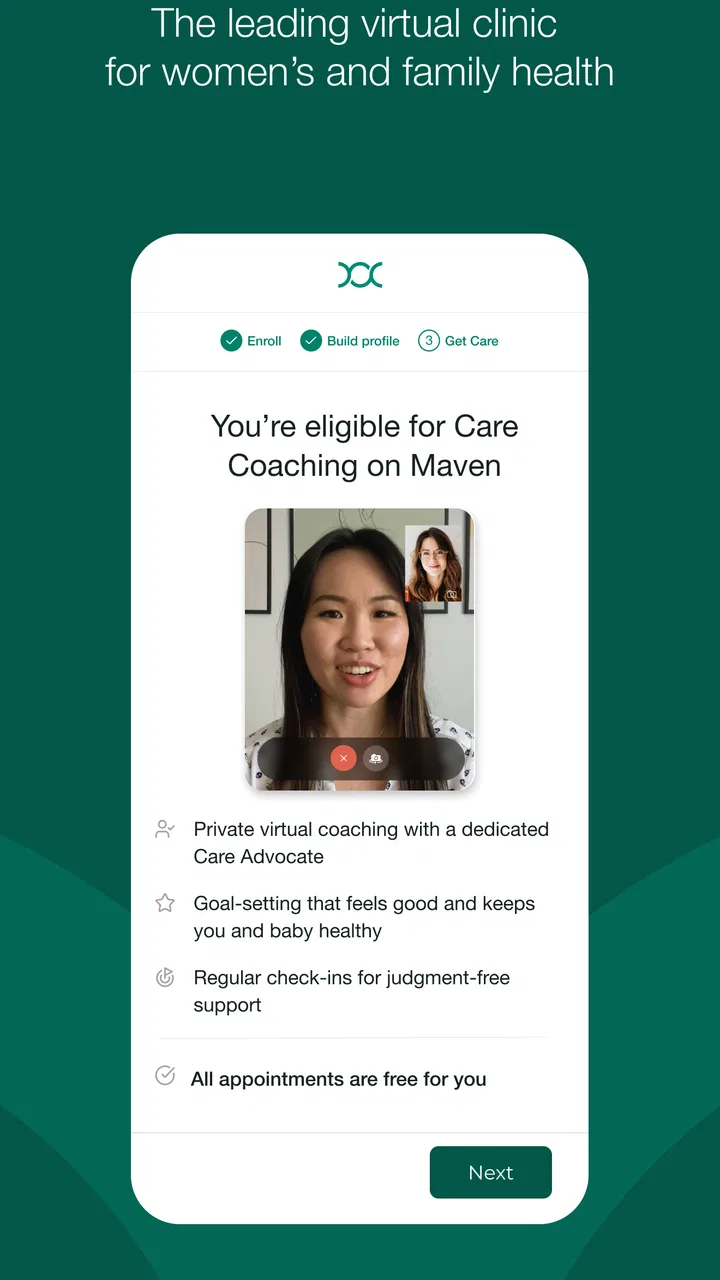
Maven Clinic
- 4.7
- Rating
- 50.00K
- Installs
- Free
- Price

 Analysis by App-foxy
When I first opened Maven Clinic, I understood its appeal quickly: it is a medical app built around virtual care for families, rather than a general health tracker or a simple appointment calendar. That distinction matters. The useful question is not whether it can replace every part of healthcare, but whether it can make the first step feel less complicated when you need guidance, a consultation, or help deciding what to do next.
Maven Clinic is free to download, is intended for everyone, and comes from Maven Clinic Co. It sits in the Medical category and has built a strong store reputation, with a 4.7 average from around 579 ratings. The app has passed 50,000 installs, which gives it a meaningful presence without making it feel like an anonymous utility. I found the experience most valuable when I treated it as a front door to virtual family care, not as a substitute for emergency services or an in-person clinician.
What to expect before you begin
The first thing a new user should know is that the app’s value depends heavily on the care access connected to their account. Installing a medical app does not automatically mean every consultation or service will be available to every person. Your experience can depend on how your access is arranged, so it is sensible to approach the first launch as an orientation step rather than expecting an instant diagnosis.
You May Also Like

 Blood Strike: 2.5 Anniversary
Blood Strike’s Loadouts Turn Every Drop Into a Tactical Gamble
A close look at Blood Strike’s custom loadouts: how fast access to signature weapons reshapes its battle royale rhythm, rewards preparation, and narrows the gap between fights.

 Pandora - Music & Podcasts
Pandora’s Music Is Easy to Start, but Harder to Recover
Pandora’s strength is its low-effort path from a seed to a station. Its weak spot is how much confidence it asks you to place in connection, setup, and quiet recovery.

 8 Ball Pool
 Is Built on Rivalries, Rematches, and Routine
A close look at the rivalries, rematches, shared routines, and unanswered safety questions that turn a quick pool match into a persistent mobile community.

 Samsung Music
’s Quiet Strength Is Playing What You Already Own
Its reach comes less from spectacle than from dependable access to a personal library. That simplicity is both the app’s strongest retention engine and its ceiling.

 AccuWeather: Weather Radar
AccuWeather Review: A Quick, Clear Forecast for Everyday Decisions
For everyday plans, the best forecast is the one you can understand quickly. AccuWeather makes rain timing, radar, and local conditions easy to act on, with a few trade-offs.

 Hill Climb Racing
Why Hill Climb Racing Still Turns Crashes Into One More Run
A tiny car, a bumpy hill and one more upgrade: Hill Climb Racing keeps resurfacing because its simple chaos makes every near-miss feel personal.
More From Our News Desk
View All News


That may sound obvious, but it prevents a common disappointment. People often download a healthcare app while worried, then assume the opening screen will immediately solve the problem. A better expectation is more practical: Maven Clinic can help organize the route to virtual support, but you still need to explain your situation clearly and follow the appropriate clinical advice.
I also would not use it as the only tool for an urgent or life-threatening situation. If someone is struggling to breathe, has severe chest pain, shows signs of a stroke, or faces another emergency, contacting local emergency services is the right move. A virtual-care app is better suited to questions, guidance, planned support, and situations where speaking with a healthcare professional remotely is appropriate.
The family focus is important. A parent, caregiver, or person managing several health concerns may appreciate having a dedicated place to begin instead of searching through unrelated websites. At the same time, the app is not automatically the best choice for someone who wants detailed fitness charts, medication reminders, laboratory analysis, or a personal medical-record archive. Those are different jobs, and expecting Maven Clinic to behave like a general-purpose health dashboard can make the experience feel narrower than it really is.
One useful mindset is to prepare a short explanation before opening a consultation. Write down who needs help, what changed, when it started, what you have already tried, and what outcome you want from the conversation. This small preparation can make virtual care much more efficient because the clinician receives a clearer starting point instead of a rushed description assembled under pressure.
Setting up an account without rushing
The setup process should be approached carefully because medical information is more useful when it is accurate. I recommend using the name and contact details you normally use for healthcare, then reading each question instead of tapping through it automatically. A hurried answer can create confusion later, especially when you are managing care for a child or another family member.
Before you begin, keep any relevant information nearby: current symptoms, recent appointments, medicines, allergies, and the dates of important changes. You do not need to create a perfect medical history in one sitting, but having the basics ready reduces the temptation to guess. If you are setting the app up while tired or worried, pause whenever a question is unclear rather than entering something simply to move forward.
Another practical tip is to decide whose care you are arranging before you start. Family-oriented services can involve more than one person, and mixing your own details with someone else’s can make later conversations harder to follow. I found that thinking in terms of one person, one concern, and one immediate goal keeps the initial setup cleaner.
The app is available for devices running iOS version 12 or later. That makes it accessible to people who are not using the newest phone, although performance can still vary with the device, operating system condition, and connection quality. If the app feels slow, the cause may be the phone or network rather than the medical workflow itself, so checking the basics before abandoning the service is worthwhile.
Privacy deserves a thoughtful approach here. Any medical app involves information that should be handled deliberately. I would avoid using a shared device without checking who can see notifications, and I would think about whether message previews appear on the lock screen. These are not Maven-specific promises or hidden settings I would assume; they are sensible habits whenever health conversations take place on a personal device.
Reaching the first meaningful result
For a first-time user, the best early success is not exploring every screen. It is completing one useful care-related task with a clear next step. That might mean finding the appropriate way to request support, describing a concern well enough for a professional to understand it, or learning what kind of follow-up is recommended. The exact path can vary, but the principle stays the same: aim for clarity, not maximum app usage.
I suggest opening the app when you have enough time to read the prompts and write complete answers. Ten distracted minutes while looking after a child may be less productive than a calm session later. If the concern is time-sensitive but not an emergency, prepare the key facts first and keep your phone available for any response or instruction that follows.
A particularly useful workflow is to separate the clinical question from the emotional question. For example, “What could be causing this?” is different from “What should I do tonight?” and both are different from “Do I need an in-person visit?” Stating those separately gives the conversation more structure. It also helps you notice whether you need reassurance, a practical action, or escalation to another form of care.
Virtual care works best when the user reports changes precisely. Instead of saying that a symptom is “bad,” describe whether it is getting worse, how it affects normal activity, and whether anything makes it better or worse. This is not about using medical jargon. Plain, specific language is usually more useful than an impressive-sounding description.
For family care, record who is speaking and who the concern is about. That simple habit matters when a parent is using one phone for several people. If another family member will take over the conversation, pass along the same timeline and questions so the story does not restart from the beginning.
The most important first-use tip is to leave the app with an action you understand. If you finish a conversation still unsure whether to wait, book an appointment, monitor a change, or seek urgent help, ask for that distinction directly. A virtual consultation is more valuable when it ends with a practical plan rather than a vague impression that someone “looked at” the problem.
Where new users may become confused
The biggest source of confusion is likely to be the difference between access to an app and access to a particular care pathway. Seeing a polished healthcare interface can create the impression that every service is universally available. In practice, a user should pay attention to the options presented for their account and avoid assuming that another person’s experience will be identical.
It is also easy to confuse convenience with completeness. A remote consultation can be excellent for discussing symptoms, receiving general guidance, or deciding what kind of care makes sense next. It cannot provide every physical examination, test, procedure, or local service. If the issue depends on seeing, touching, measuring, or testing something in person, the better outcome may be a recommendation to continue offline.
Another point worth understanding is that a virtual response may not be immediate in the way a search engine is. Healthcare requires context, and the appropriate pace can depend on the question and the route you choose. I would not repeatedly submit the same concern simply because the first response does not appear as quickly as a web result. Duplicate requests can make your own record harder to follow and may not improve the answer.
Some users may also expect the app to function like a permanent personal doctor. I would avoid that assumption. It can be a useful part of a care routine, but it does not remove the need to keep track of important medical information, attend in-person appointments when advised, or follow local guidance. Think of it as a connected service for access and direction, not as the sole container for your entire health history.
The free price is a genuine advantage for trying the app, but “free to download” should not be interpreted as a guarantee that every possible healthcare service has no conditions attached. Read the information shown during setup and before committing to a particular route. That is especially important for users who are comparing virtual care with an existing provider, employer benefit, insurer arrangement, or local clinic.
How it compares with familiar alternatives
Compared with searching symptoms on the web, Maven Clinic offers a more responsible path toward a conversation with a healthcare professional. Search results can be useful for learning vocabulary, but they often encourage people to compare themselves with alarming possibilities. A clinician-focused app is better when the real need is deciding what to do about a specific person and situation.
Compared with a standard doctor’s office, virtual care can remove travel and reduce the friction of asking an initial question. That is particularly helpful for parents, people with demanding schedules, and anyone who needs guidance before deciding whether an appointment is necessary. The trade-off is that an office visit can examine the patient directly and complete tasks that remote care cannot.
Compared with a hospital or urgent-care service, Maven Clinic is less appropriate when the situation may require immediate physical treatment. The advantage is convenience for non-emergency support; the limitation is that convenience must never delay necessary in-person care. I see it as a complement to the wider healthcare system rather than a replacement for every part of it.
Compared with a symptom tracker, the app’s strength is not collecting endless daily measurements. Its usefulness is in helping a person move from concern to professional guidance. Someone who wants graphs, exercise goals, sleep trends, or long-term wellness statistics may be happier with a dedicated tracking app. Someone who wants a family-care entry point may find Maven Clinic more relevant.
Who will benefit most, and who should choose something else
I think the app is a strong fit for people who prefer to begin healthcare conversations remotely, especially when family responsibilities make travel difficult. It can also suit users who become overwhelmed by deciding whether a concern belongs with a primary-care office, a specialist, or an urgent service. Having a structured starting point can reduce that uncertainty.
It may be especially useful for a parent who needs to organize thoughts before speaking with a professional. A realistic example would be a child developing a new, non-emergency symptom late in the day. Instead of searching random forums, the parent can gather the timeline, note changes, explain what has already been tried, and use the app to seek appropriate guidance. The meaningful success is not necessarily a diagnosis; it is understanding the safest next step.
I would be more cautious about recommending it to someone who needs immediate hands-on treatment, has a complex condition requiring regular physical monitoring, or wants one app to replace every existing healthcare relationship. It may also disappoint users who are mainly looking for wellness statistics or a broad medical encyclopedia. In those cases, an in-person provider, emergency service, specialist system, or dedicated health tracker may be a better match.
People who dislike writing details on a phone may also find virtual care less satisfying than a familiar clinic visit. The app can lower travel friction, but it does not remove the need to communicate clearly. If you know you will minimize symptoms, forget dates, or close the conversation without understanding the plan, prepare notes in advance or ask someone you trust to help you organize the information.
Small habits that make the experience better
My first recommendation is to create a reusable symptom note outside the app, using plain language and dates. Keep it short: what happened, when it began, what changed, and what question you need answered. This is more useful than writing a long emotional account that hides the timeline. Update it before a consultation rather than trying to reconstruct everything from memory.
Second, use one conversation to resolve one main decision whenever possible. A list of ten unrelated concerns can make it difficult to identify the most urgent issue. If several family members need help, separate their notes and describe each person independently. This is a simple organizational technique, but it can significantly improve the quality of a remote exchange.
Third, after receiving guidance, repeat the plan in your own words. Ask what signs should prompt a change in action, what timeframe matters, and whether an in-person visit is needed. This is not being difficult; it is a way to catch misunderstandings while the conversation is still active.
Fourth, do not judge the app only by how fast it opens or how attractive its screens feel. Medical usefulness is measured by whether you can move from uncertainty to an understandable decision. A quiet, uneventful interaction can be a success if it prevents unnecessary worry or helps you seek the right level of care.
My view after using it
Maven Clinic is a focused medical app with a clear role: helping families approach virtual care in a more organized way. I like that its purpose feels practical rather than centered on collecting health data for its own sake. The free entry point and everyone age rating make it approachable, while the current version, 202608.2.0, shows that the app remains actively maintained as part of its ongoing product experience.
Its limitations are just as important as its convenience. It cannot turn remote care into a physical examination, it should not be treated as an emergency channel, and the available experience may depend on the access connected to your account. Those are not reasons to dismiss it; they are boundaries that help you use it responsibly.
Overall, I would recommend trying Maven Clinic if you want a calmer first step for family health questions and you are comfortable communicating details through a digital service. Start with one person and one concern, prepare a short timeline, and aim to finish with a clear next action. If your situation requires immediate treatment or hands-on assessment, choose the appropriate in-person option instead. Used within that boundary, Maven Clinic can make the path from “I am not sure what to do” to “I understand my next step” noticeably easier.
FAQs for Maven Clinic
01What is Maven Clinic, and who is it designed for?
Maven Clinic is a digital healthcare platform focused on women’s and family health. It provides access to virtual consultations, educational resources, care programs, and health guidance through a mobile app or web browser. Depending on the plan offered by an employer, insurer, or organization, members may find support for fertility, pregnancy, parenting, menopause, pediatrics, mental health, nutrition, and general wellness.
02Is Maven Clinic free to download and use?
Downloading the Maven Clinic app is generally free, but access to its services depends on eligibility. Many users receive membership through an employer, health plan, or other participating organization. Some features may be included at no additional cost, while coverage, appointment availability, and possible charges can vary by plan. It is best to confirm eligibility with your employer or insurer before booking care.
03Can I speak with a doctor or healthcare specialist through Maven Clinic?
Yes, Maven Clinic can connect eligible members with healthcare professionals through virtual appointments, depending on their available benefits and location. Services may include consultations with physicians, nurses, therapists, specialists, coaches, and other providers. Appointment types and response times vary, and virtual care may not be appropriate for emergencies or conditions requiring a physical examination or immediate in-person treatment.
04What health services and programs are available in Maven Clinic?
The services available in Maven Clinic depend on your membership, but the platform commonly includes programs covering fertility, pregnancy, postpartum care, adoption, surrogacy, parenting, pediatrics, menopause, mental health, nutrition, and general women’s health. Users may also access articles, care guides, appointment scheduling, messaging, and personalized support. Not every program is available to every member or in every country.
05Is Maven Clinic suitable for urgent medical problems or emergencies?
Maven Clinic is intended for scheduled virtual healthcare, education, and ongoing support rather than emergency treatment. If you have severe symptoms, chest pain, trouble breathing, heavy bleeding, signs of stroke, or another potentially life-threatening problem, contact local emergency services immediately. For less urgent concerns, the app may help you decide what type of care to seek, but it should not replace an in-person medical evaluation when one is necessary.
Pros
- Virtual visits make healthcare accessible from home.
- Offers support for fertility
- maternity
- and parenting needs.
- Care plans can be tailored to individual health goals.
- Provides access to a multidisciplinary care team.
- Useful educational resources help users make informed decisions.
Cons
- Availability may depend on an employer or health plan.
- Some services and benefits vary by location.
- Appointment availability can differ between specialties.
- Not intended for emergency medical situations.
- Certain treatments may require in-person follow-up care.

Maven Clinic
Gallery